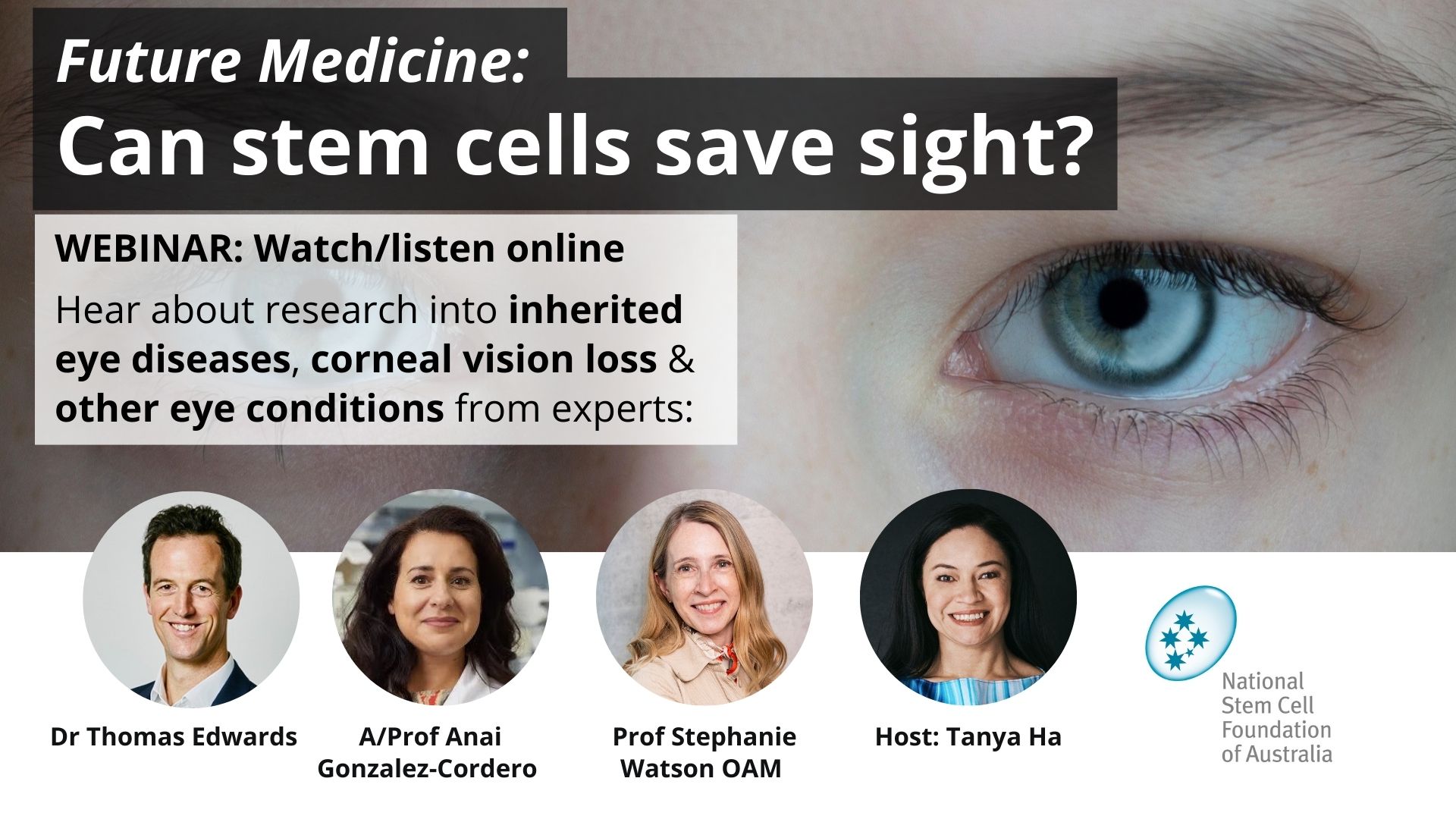
Hear the latest science and bring your questions to a free online event at 7:00pm AEST Thursday 21 May 2026.
Could stem cells help prevent vision loss or even restore eyesight?
Find out how stem cells are helping us understand and potentially treat causes of blindness and low vision including inherited eye diseases such as retinitis pigmentosa, Stargardt disease, Usher syndrome, and acquired conditions, such as corneal damage.
Three of Australia’s top stem cell researchers and eye clinicians will join a live online audience to explore the topic and answer questions in the webinar event Future Medicine: Can stem cells save sight?
Register to attend via Humanitix: https://events.humanitix.com/future-medicine-can-stem-cells-save-sight.
More than 453,000 Australians are blind or vision impaired, affecting their ability to read, work, drive, take part in hobbies, and other activities. Prescription glasses and contact lenses help many people, but some eye injuries and diseases are currently beyond repair or cure.
About 19,000 Australians have an inherited retinal disease[1], caused by genetics. The lifetime cost of living with an inherited eye disease in Australia is about $5.2 million per person[2]. Corneal blindness affects all ages and burdens over 2 million people worldwide.
The good news is that scientists and clinicians working with stem cells are:
- developing lab-grown or patient-derived healthy eye stem cells for transplantation to treat corneal blindness.
- running clinical trials for gene therapies targeting inherited eye diseases, which could potentially stop vision loss from progressing or even restore some sight.
- using a patient’s own cells to better understand their eye disease, test treatments, and potentially develop new cell sight-saving therapies.
Find out more from our panel of researchers and clinicians who are working on:
- clinical trials for gene therapies for age-related macular degeneration and inherited eye diseases such as retinitis pigmentosa: clinician-scientist and vitreoretinal surgeon Dr Tom Edwards, Centre for Eye Research Australia
- finding ways to repair or replace photoreceptor (light-sensing) cells in the eye damaged by the genetic conditions Stargardt disease and Usher syndrome: cell biologist Associate Professor Anai Gonzalez-Cordero, Children’s Medical Research Institute
- stem cell treatments for corneal damage and limbal stem cell deficiency: ophthalmic surgeon Professor Stephanie Watson OAM, University of Sydney, Sydney Eye Hospital, Sydney Children's Hospital, and Prince of Wales Hospital.
The webinar is presented by the National Stem Cell Foundation of Australia and hosted by Science in Public’s director of engagement Tanya Ha.
More about the speakers:
Dr Thomas Edwards is an eye surgeon and leads a research team investigating retinal gene therapy at the University of Melbourne affiliated Centre for Eye Research Australia (CERA) based at the Royal Victoria Eye and Ear Hospital. His clinical interests include diseases of the vitreous and retina, including age-related macular degeneration, diabetic retinopathy and inherited retinal degenerations. He is one of a handful of surgeons in Australia who has expertise in retinal gene therapy surgery and also has an interest in technical innovations such as robotics. In 2020, the Foundation provided $50,000 to support Tom’s research into gene therapies for inherited eye diseases through our Matched Funding Program.
Associate Professor Anai Gonzalez-Cordero is a leader in the field of stem cells and their differentiation into organoids with an emphasis on research to develop new therapies for retinal genetic diseases that cause vision loss, such as Stargardt disease and Usher syndrome. She is an Al & Val Rosenstrauss Fellow, a Group Leader of the Stem Cell Medicine Group and Head of the Stem Cell & Organoid Facility at the Children’s Medical Research Institute (CMRI). In 2022, she won the Metcalf Prize for Stem Cell Research.
Professor Stephanie Watson OAM is an eye surgeon specialising in cataract, corneal and laser surgery, with expertise in eye disease in adults and children. She is known for her translational research into stem cell treatment for corneal blindness which has been supported by the Medical Research Future Fund (MRFF).
Stephanie is Head of Ophthalmology and the Corneal Research Group at the University of Sydney Save Sight Institute; Head of the Corneal Unit at the Sydney Eye Hospital; and appointed at Sydney Children’s Hospital, Prince of Wales Hospital.
She has served on the MRFF Stem Cell Therapies Mission Expert Advisory Panel.
Tanya Ha (moderator) is Director of Engagement at Science in Public, where she has looked after communication for the National Stem Cell Foundation of Australia, among other clients, for more than 10 years. She is also an award-winning science journalist, television presenter, author, speaker and sustainable living advocate.
References:
[1] https://www.cera.org.au/conditions/inherited-retinal-diseases/
[2] https://www.cmrijeansforgenes.org.au/news/cost-of-going-blind-calculated-for-first-time-as-5-2m

Showing 1 reaction